
Released in the early 1970s, the TEAC AX-300 is a 6:4 analog mixer built for the golden age of home multitrack. Conceived as the mixing companion to TEAC's legendary 4-channel...
Availability: Low stock: 4 left
Couldn't load pickup availability


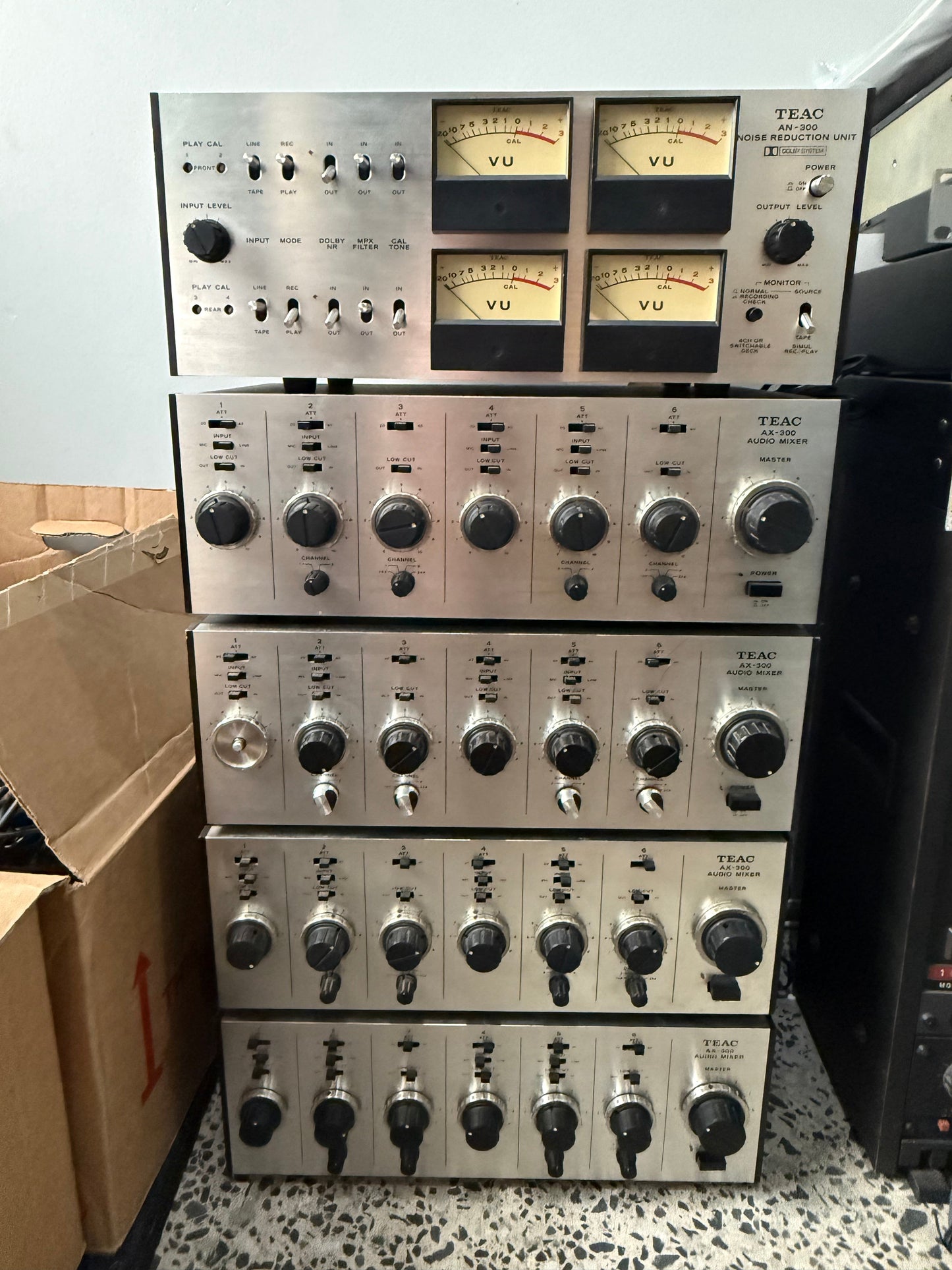

Released in the early 1970s, the TEAC AX-300 is a 6:4 analog mixer built for the golden age of home multitrack. Conceived as the mixing companion to TEAC's legendary 4-channel simul-sync decks (the 2340 and 3340), it routes six inputs into four channels through discrete Class-A circuitry and Tamura input transformers, the same iron that gives so much 1970s Japanese gear its warm, silky midrange. Channels 3 and 6 are XLR only, every channel carries switchable 20dB or 40dB attenuation, and a genuinely useful low-cut switch keeps vocals natural without thinning them out. Add an exceptionally low noise floor and flexible sub-channel routing, and you have a transformer-balanced front end that punches well above its modest size. Rare now and quietly treasured by analog purists, it is a piece of recording history that still earns its place in a working studio.
WE HAVE FOUR OF THESE. Buy one, or build a stack. Read on.
FEATURES
PROS
STACK THEM: BUILD A BIGGER DESK
This is the part most people miss. The AX-300's sub-channel routing and its eight line outputs mean these units were built to gang together, and we have four from the same family. That opens up console configurations you simply cannot buy new at any sane price:
Stacked, they also look the part: four slabs of brushed aluminium and black iron, which is why the photo of two of them piled up sells this better than any spec sheet.
GENRE / USE
THE WORD: Vintage dealers and the analog community hold the AX-300 in high regard, describing it as a rare, discrete, transformer-balanced mixer with warm Class-A preamps, unusually flexible routing and a remarkably quiet noise floor, the kind of early TEAC engineering that collectors actively hunt down. See the listing on Reverb.
PAIRS WITH: The matching TEAC AN-300 noise reduction unit from the same set is available separately. One only.
SPECIFICATIONS
Further reading: Two EQ Knobs and a Fader: How the Golden Age of Highlife Was Actually Recorded


